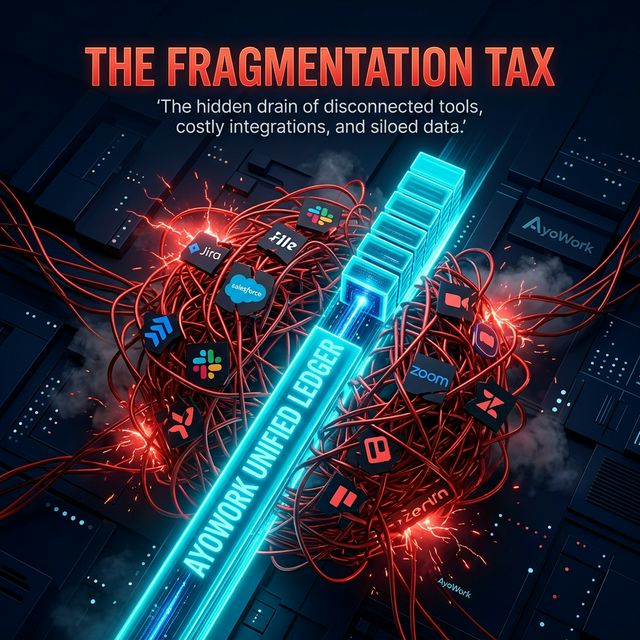
The average modern business is paying a massive, invisible tax—one that doesn’t go to the government. At AyoWork, we call this the “Fragmentation Tax.”
Most small to medium-sized enterprises utilize a dozen different SaaS applications to run their daily operations. Commerce happens on Shopify, payment processing on Stripe, banking on Chase, and fulfillment on ShipStation. While each individual tool is highly optimized, the ecosystem as a whole is fundamentally broken. This hyper-distribution of operational data has created what we call the Fragmentation Tax.
Table of contents
- The Hidden Cost of Manual Reconciliation
- How Your Current Workflow is Leaking Profits
- The Big Fix: The Unified Ledger
- Summary: Eliminating Data Silos for Good
The Hidden Cost of Manual Reconciliation
The Fragmentation Tax is paid in human hours. It’s the cost of downloading CSVs from e-commerce platforms, payout reports from processors, and feeds from banks, then spending days in Excel trying to map a single batch deposit back to 40 individual line-item sales.
THE COST: The average business owner or bookkeeper spends 10–20 hours per week simply serving as the “human glue” between platforms. This is an invisible drain on both profitability and morale.
How Your Current Workflow is Leaking Profits
Fragmentation isn’t just an annoyance; it’s a strategic liability. By operating across disconnected silos, you are accepting three major risks:
- Data Latency: Decisions are made using stale data because reconciliation only happens once a month.
- Error Propagation: Manual data entry between siloed apps inevitably leads to mathematical discrepancies.
- Operational Friction: Your best talent is wasted on repetitive administrative tasks instead of growth strategies.
The Big Fix: The Unified Ledger
You cannot solve the Fragmentation Tax by building fragile, point-to-point integrations that break every time an API updates. You solve it through complete Financial Gravity.
At AyoWork, we eliminate data silos fundamentally through a Unified Ledger architecture. Rather than trying to sync fragmented databases to each other, AyoWork acts as the central planetary mass that pulls all disparate data strings into a single, immutable core.
How the Unified Ledger Eliminates the Tax
- Raw Data Ingestion: Our Agentic Architecture autonomously pulls raw event data from every endpoint the millisecond a transaction occurs.
- Algorithmic Verification: Specialized AI agents trace every sale, fee, and payout, establishing a mathematically verified chain of custody.
- A Single Source of Truth: By the time you log in, the data is already matched and secured.
Summary: Eliminating Data Silos for Good
When your data exists in a Single Source of Truth, the Fragmentation Tax drops to zero. Our Invisible Workforce handles the complexity of reconciliation so you don’t have to. Here are the key takeaways:
- Human Glue is Obsolete: Stop wasting talent on manual data mapping.
- Mathematical Certainty: The Unified Ledger ensures every transaction is verified at the source.
- Real-Time Clarity: Move from “monthly closes” to “continuous accounting.”
- Strategic Focus: Reclaim the hours needed to actually grow your business.
Q&A
Q: How does AyoWork handle different currencies in a fragmented stack?
A: Our Unified Ledger includes a real-time FX (Foreign Exchange) engine that automatically normalizes every transaction into your base currency at the point of ingestion.
Q: Can I keep using my favorite niche SaaS tools?
A: Yes. AyoWork is designed to sit above your existing stack as an integration layer. We don’t ask you to change your tools; we simply change how those tools communicate with your financial core.